
 Wayne Bodie Books
Somewhere along the way, sharing a little piece of your life became a competitive sport.
A photograph needed likes. A passing thought needed engagement. A creative idea needed the right headline, the right hashtags, and preferably an appointment with the algorithm at precisely the right moment. Then came the familiar ritual of checking back to see whether anybody had noticed.
It's a curious development when you think about it. We invented extraordinary technology that allows people to communicate across the world, and somehow managed to make sharing a picture of your cat feel like a performance review.
At Wayne Bodie Books, we've spent considerable time creating things for the internet. Books, original music, videos, articles, and digital publishing have all become part of our independent studio. We appreciate the opportunities that online platforms provide, but we've also become increasingly interested in a different question: What would publishing look like if we stopped designing everything around the pursuit of attention?
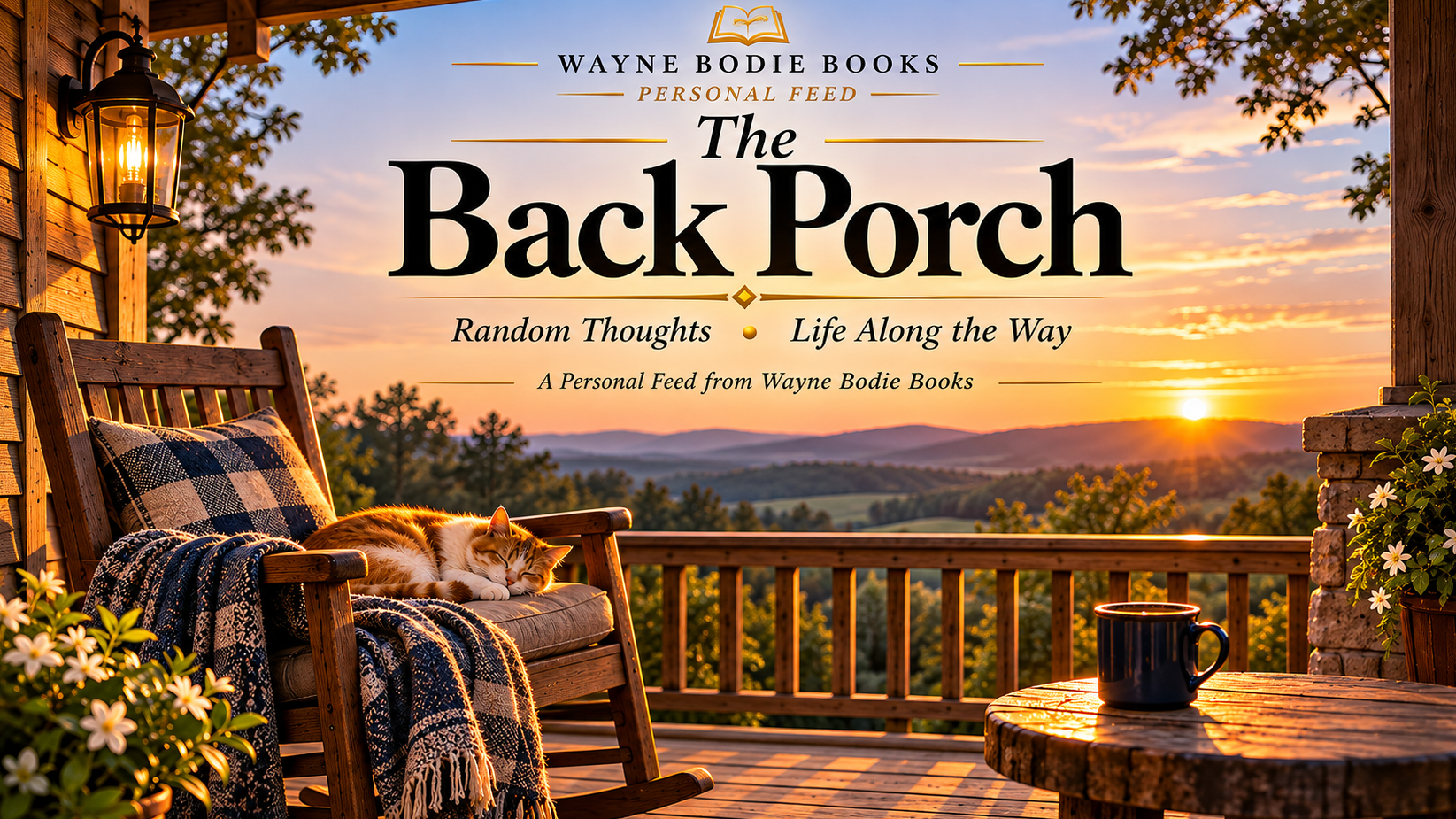
That question eventually led us to The Back Porch, our own little social feed.
The Machinery Behind the Modern Social Feed
To understand why we wanted something different, it helps to understand how the larger platforms operate.
When you open a major social network, you aren't necessarily seeing everything your friends or favorite creators posted in chronological order. You're often seeing a selection arranged by software designed to predict what will interest you.
These recommendation systems consider signals such as what you click, how long you watch something, which posts you engage with, and what has interested you before. Their ability to sort enormous amounts of information is genuinely useful. Without some form of organization, finding anything worthwhile among millions of posts would be difficult.
But there's another consideration: your attention has economic value.
For advertising-supported platforms, continued engagement creates additional opportunities to display advertisements. The result is a powerful incentive to develop experiences people want to keep using.
Consider infinite scrolling. An old-fashioned newspaper eventually reaches its final page. Many modern social feeds don't. The next photograph, argument, joke, or extraordinary headline is always another swipe away.
And you never quite know what that next swipe will bring.
That's where the comparison to a slot machine becomes interesting.
The Slot Machine in Your Pocket
A slot machine keeps people guessing about what might happen next. Rewards are uncertain, and that uncertainty can encourage repeated behavior.
Social media operates differently from gambling, but certain elements of its design can take advantage of similar learning processes. Sometimes you receive a wonderful response to something you share. Sometimes nobody notices. Occasionally, something you never expected attracts an extraordinary amount of attention.
That unpredictability can become part of the appeal.
Researchers examined this phenomenon in a 2021 study published in Nature Communications. Analyzing more than a million social media posts and conducting an experiment, they found that social rewards such as likes can influence when and how frequently people post.
Dopamine is often mentioned in conversations about these systems, although it deserves a more careful explanation than the popular idea of a chemical that simply makes us happy. Dopamine plays important roles in motivation, learning, and our responses to anticipated rewards. It is part of a complex process, not proof that everyone scrolling through a feed is addicted.
The National Academies' 2024 report on social media also examines recommendation algorithms, engagement-driven design, and the challenges of understanding their effects. Researchers continue to debate the extent to which different features affect different people.
We're not claiming that every platform deliberately harms its users. Social networks can help families stay connected, introduce people to worthwhile ideas, and give small creators opportunities that would have been unimaginable a generation ago.
But something can be useful while still encouraging habits we would rather not develop.
And the more we thought about that, the more we wondered whether we wanted to organize our own creative lives around the same incentives.
When Sharing Becomes Performing
There's another side to the story that receives less attention: what happens to the people creating all that content.
When everything is measured, it's easy to start measuring ourselves.
A thoughtful article might receive little attention, while a ridiculous ten-second video attracts thousands of views. A meaningful photograph disappears almost immediately, while an argument travels halfway around the world.
Before long, creators can find themselves wondering less about what they want to say and more about what the system might reward.
We've experienced enough of that world to recognize the temptation. We've published material we cared about, watched numbers rise and fall, tried different approaches, and wondered why certain things reached people while others seemed to vanish.
Eventually, a reasonable question emerged.
Does every little thought really need an audience, a strategy, or a performance metric attached to it?
Perhaps some things are worth sharing simply because we want to share them.
Why We Built The Back Porch
The name came naturally.
A back porch isn't usually where you deliver a polished presentation. It's where you sit down, enjoy a little fresh air, tell a story, share an observation, or watch the world go by.
Sometimes the conversation is serious. Sometimes it's funny. Sometimes somebody shows up with a photograph of a cat, and that's the entire afternoon's excitement.
We wanted an online version of that feeling.
The Back Porch is a personal publishing space connected to Wayne Bodie Books. It's a place for everyday thoughts, photographs, creative experiments, observations about life and faith, and occasional studio updates that don't require an elaborate production.
We weren't trying to build another popularity contest. We wanted to move away from the pressure of follower-scorekeeping, public engagement numbers, and the constant question of whether a particular post would perform.
We also weren't trying to replace Facebook, YouTube, or any of the major social networks. They still have useful roles in sharing our work and connecting with people.
We simply wanted a little corner of the internet where our thoughts could exist without first having to satisfy somebody else's recommendation system.
We wouldn't describe it as a technologically perfect sanctuary or pretend that owning a website solves every problem associated with online communication. A calmer experience is something we have to create through our choices, not something a web address automatically guarantees.
But we can decide what matters to us.
And that's a surprisingly liberating thought.
A Natural Progression
Looking back, The Back Porch was almost inevitable.
Our books have their own home. Our original music can be heard through WBB Radio. Our Journal gives longer stories and reflections room to breathe. Our podcast adds another way to share faith, encouragement, and everyday experiences.
The Back Porch fills a different need.
Not every thought deserves an entire article. Not every observation needs a video. Sometimes an idea isn't fully developed, and sometimes the photograph itself is the entire story.
We wanted somewhere for those moments to live.
Whether five people visit or five thousand, the purpose doesn't have to change.
We built it because we wanted it to exist.
And perhaps that's a perfectly reasonable reason to create something.
Pull Up a Chair
There's an old-fashioned comfort in the idea of a porch. Nobody has to impress anybody. The conversation can wander. Silence is allowed. And there's no requirement that every subject be important.
That's the spirit we're hoping to bring to our little experiment.
You're welcome to visit The Back Porch whenever you like. You might find a little studio news, a passing thought about Scripture, something we're working on, or a photograph that made us smile.
We make no promises about what you'll find on any particular day.
That's rather the point.
After all, sometimes you don't need an audience.
You just need a porch.